As someone who plays Overwatch 2 regularly on console, I've been directly affected by the recent change that has stirred up a significant portion of the community. Blizzard, in its efforts to manage the cross-play experience, has disabled aim-assist for console players specifically when they are matched against opponents on PC. This decision, intended perhaps to create a more level playing field, has instead sparked widespread discontent among those of us who use controllers. The feeling of being at an inherent disadvantage is palpable in every casual match where I find myself facing off against PC players, and it has fundamentally altered my enjoyment of the game.
From my experience and that of many others, the precision gap between a mouse and keyboard setup and a standard controller is not trivial. A mouse allows for swift, flick-of-the-wrist targeting that a thumbstick simply cannot match in raw speed and accuracy. The aim-assist feature on console was never a tool for creating an unfair advantage, but rather a necessary compensation for this fundamental input disparity. Without it, the playing field feels anything but level; it feels tilted. One player on social media perfectly captured the sentiment, saying their console friends now find "less enjoyment out of the game being disadvantaged in this way." This isn't about wanting an edge—it's about wanting a fair fight.
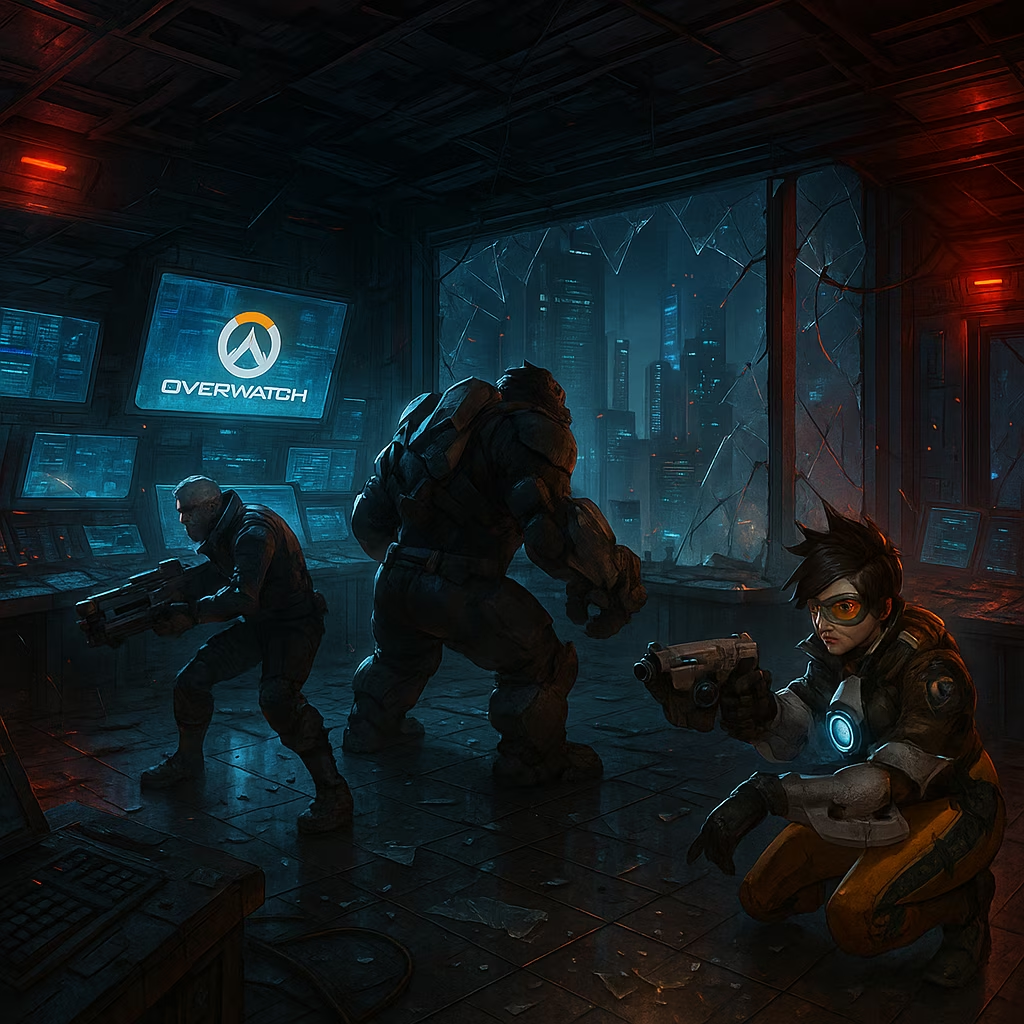
It's crucial to note that this change only impacts casual, cross-play matches. The competitive ladder remains segregated by platform, preserving integrity in ranked play. However, for the vast majority of players who engage in quick play or other casual modes, this adjustment has been jarring. Blizzard has remained notably quiet about its official reasoning, leaving the community to speculate. The prevailing theory is that this is a push for uniform fair play in cross-play environments, but the execution feels like it unfairly penalizes one group to theoretically benefit another. The core issue remains unresolved: the inherent mechanical differences between the two control schemes.
This aim-assist controversy is, unfortunately, just one item on a growing list of challenges that have marked Overwatch 2's launch period. The game's debut was far from smooth:
-
Severe Server Instability: The servers were hit with DDoS attacks, creating massive login queues that stretched for thousands of players.
-
Frustrating Gameplay Bugs: A particularly alarming bug temporarily locked out nearly half of the game's heroes for all players, even though the underlying issue only affected a few.
-
Monetization Glitches: Perhaps most egregious was a store bug that caused players to unintentionally purchase cosmetic skins, with Blizzard initially refusing to offer refunds for these erroneous transactions.
Despite these significant hurdles, it's important to acknowledge that the development team has been working diligently. Patches have been deployed to address the purchasing bug and hero locks, demonstrating a commitment to stabilizing the experience. Yet, each fix seems to be followed by a new wave of community feedback or an unforeseen issue, keeping the game in a state of flux. The question of whether the aim-assist removal is a permanent fixture or a temporary adjustment in this rocky launch phase remains unanswered.
Looking at the broader landscape of competitive shooters in 2026, the input debate is more relevant than ever. Many successful titles have found ways to balance cross-play, often by implementing input-based matchmaking or carefully tuned aim-assist that doesn't feel oppressive to either side. Overwatch 2's current approach feels like a blunt instrument. For console players, the joy of playing with friends on other platforms is now tempered by the frustration of feeling outgunned in every direct duel. The community's vocal reaction is a clear signal that this solution may not be the right one. As we move forward, I, along with many other players, hope Blizzard re-evaluates this decision, provides clear communication, and finds a middle ground that respects the skill of all players, regardless of their chosen hardware.
As reported by CNET - Gaming, cross-play features often expose the real-world friction between different input devices, making design choices like aim-assist tuning as much a user-experience decision as a competitive one. In Overwatch 2’s case, removing aim assist for console players in PC lobbies can make casual matches feel lopsided rather than “fair,” suggesting that solutions like input-based matchmaking or more nuanced assist scaling may better preserve the social value of cross-play without undermining controller viability.
Comments