You know, it’s wild to think back to that April day in 2022 when the Overwatch 2 beta finally dropped. I’d been waiting since that cinematic trailer in 2019, and honestly, the drought of updates felt like an eternity. Game director Aaron Keller later admitted they’d let the community down on communication, but when those beta signups went live and the website immediately buckled under the traffic, we all knew something huge was brewing. I was one of the lucky ones who snagged access by tuning into Blizzard-approved streamers for four hours on April 27th—people were practically flocking to Twitch like it was a global holiday. And, boy, did the numbers prove it.
I still remember the screenshot circulating of that insane viewership spike: Over 1.5 million people watching the beta’s debut in just 24 hours. The official Overwatch Twitter account—now just a memory of a different era—proudly boasted that it smashed anything the original game had ever achieved on the platform. For context, the first game’s peak was around 500K concurrent viewers during major events. This beta blew past that like a rocket, and it wasn’t even a full release! The hype was so palpable you could practically taste it through the screen. I’d argue it set a new standard for how a game’s early playable test can tap into a ravenous fanbase. And that came even after the disturbing lawsuit filed by the California Department of Fair Employment and Housing—alleging abuse, discrimination, and retaliation at Activision Blizzard—had cast a long shadow over the company. (I won’t dwell on the grim details, but it’s part of the messy backstory that makes the beta’s success all the more striking.)
When I finally booted up the beta on my PC (remember, it was PC-only back then, leaving console players green with envy), the first thing that hit me was the pace. The switch from 6v6 to 5v5 felt like ripping off a weighted blanket. Matches were faster, less bogged down by chokepoints that used to turn entire rounds into a slog. I’d spent years grinding Double Shield vs. Double Shield standoffs, and suddenly, with one less tank, the action was fluid and chaotic in the best way. I immediately jumped into the new Push mode—a tug-of-war struggle where two teams fight to escort a giant robot into the enemy’s base—and it was a revelation. No more stalling on payload checkpoints; it was constant, dynamic brawling that demanded you adapt on the fly.
The developer had also reworked several heroes, and trying them out felt like unwrapping a gift with every log-in. Here’s a quick rundown of the changes that had everyone talking:
-
Orisa lost her barrier and Halt! entirely, morphing into a brawling beast with an energy javelin and a spinning spear that could block projectiles. She became a frontline bully instead of a backline camper.
-
Doomfist transitioned from a damage dealer to a mobile tank with a power block ability, letting him absorb attacks and punch back harder. It was weird at first, but so satisfying to pull off.
-
Bastion got a huge overhaul: his self-repair was gone, he could move while in Assault Config, and his ultimate turned into an artillery strike. No more stationary turret memes!
-
Sombra could now hack enemies while cloaked, and her Hack ability lasted longer but with a cooldown, giving her a hit-and-run identity that felt more impactful.
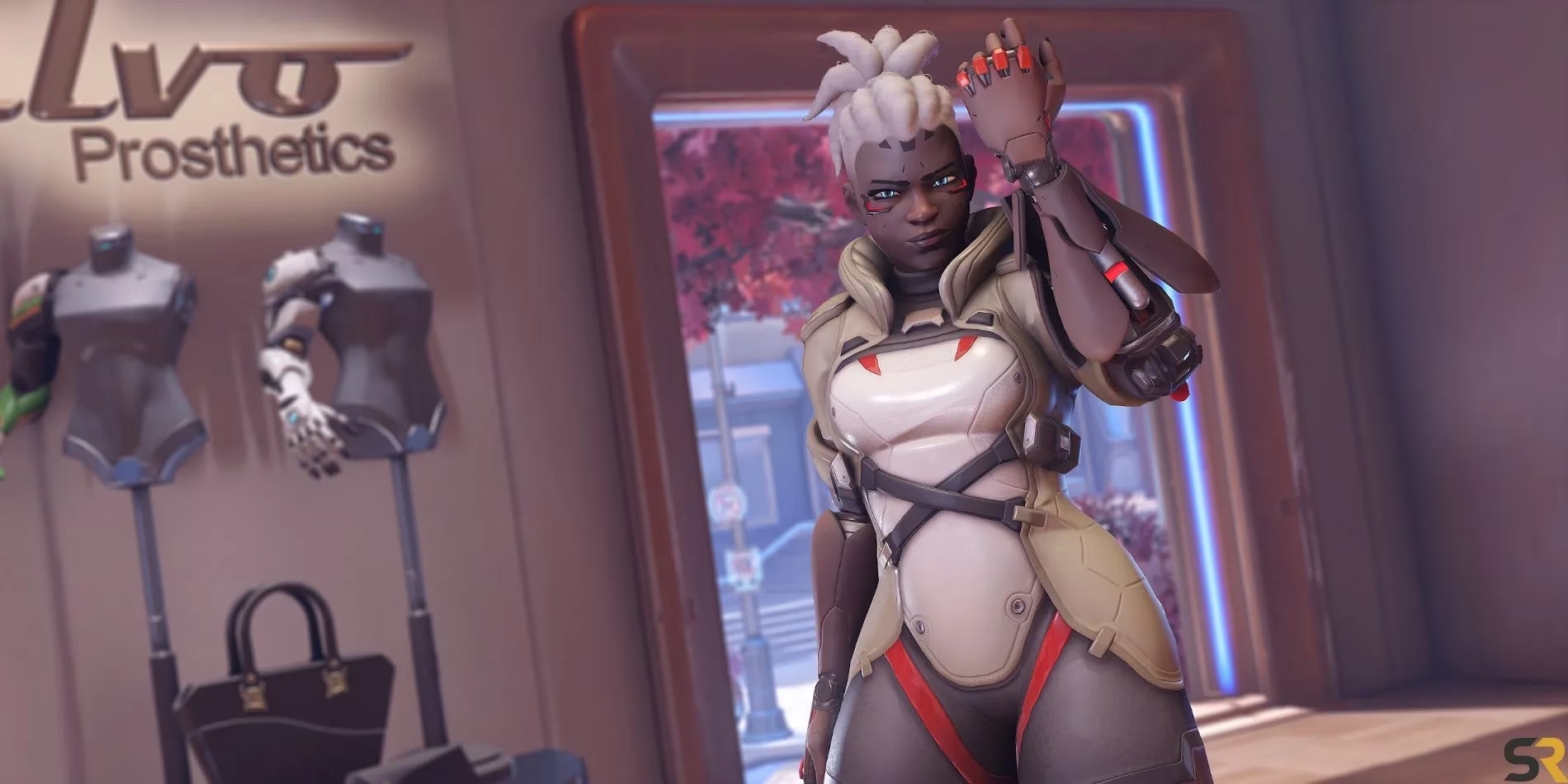
And then there was Sojourn. Our brand-new damage hero. I queued up as her instantly, and within an hour I was hooked on her railgun mechanic—charging it up with primary fire to unleash a devastating hitscan shot. She was slippery, deadly, and her slide-jump gave me action-hero vibes. The beta’s four new maps (Circuit Royal, Midtown, New Queen Street, and Colosseo) also slapped. Each one felt designed with the new 5v5 philosophy in mind, with multiple flank routes and less oppressive sightlines. I remember staying up until 3 a.m. just experimenting with the reworks and cackling every time I knocked someone off the map.
Fast forward to 2026, and it’s night-and-day compared to those beta days. Overwatch 2’s PvP modes went free-to-play that October, and while the launch was rocky—servers choked harder than a gold-ranked Genji—the player count exploded. The PvE campaign, which had been teased as a co-op story-driven experience with customizable heroes, finally arrived in 2024 after a prolonged separation from the PvP side. It didn’t quite live up to the sky-high expectations (I still see threads debating whether the talents system was deep enough), but playing through the Null Sector invasion with buddies was a blast. The beta’s 5v5 format stuck, though, and it’s now the competitive bedrock. The Overwatch League has since undergone its own transformations—remember when they played an early build of OW2 back in that 2022 esports tournament?—and the meta has swung wildly from rush comps to dive to whatever monstrosity a new hero like Juno or Emre brings.
That record-breaking Twitch viewership? It wasn’t just a fluke. It signaled that the community was still hungry. The beta’s success gave Blizzard a much-needed win after a string of controversies and delays. Watching streamers like xQc and Emongg rack up six-figure audiences while they fumbled with the new reworks was pure entertainment—and for many, the four-hour watch-to-earn drop was the only gateway to actually touching the game early. I know friends who left streams running on mute while they slept just to get that beta key. And you know what? It worked. The beta ran until May 17th, and every day I saw fresh content flooding YouTube and Reddit, picking apart every pixel of Sojourn’s kit or theorizing about the next unannounced hero. (Remember when fans spotted what they thought was a fox-themed support in the background of a cinematic? Ah, the guessing games.)
Looking back, the Overwatch 2 beta was more than a test—it was a cultural reset for the franchise. It proved that a sequel didn’t need a full release to dominate the conversation. The 5v5 shift, the hero reworks, Push mode, Sojourn—they were all bold bets that paid off. Sure, the game has evolved enormously since then. We’ve got cross-progression across all platforms, a seasonal battle pass that never stops stirring drama, and lore updates that finally told us what happened to Winston and the team after the Recall. But whenever I load into a Push match on Toronto’s snowy streets, I still get a little flash of that first beta weekend: the janky FPS, the “what does this button do?” panic, and the sheer electricity of millions of us discovering a new Overwatch together. Even now, in 2026, I think that beta set a standard for how you hype up a game’s rebirth—even if the road from there was anything but smooth.
So, if you’re a newer player who joined when Overwatch 2 went free-to-play, you missed out on a wild moment in gaming history. The beta’s Twitch numbers still stand as a testament to what happens when a community’s patience finally snaps—in a good way. And if you were there, you’ll never forget the chaos. I’ll leave you with this: next time a beta drops and you see those spiking viewership charts, ask yourself if it can beat 1.5 million. Overwatch 2 already raised the bar. 🚀
Comments